

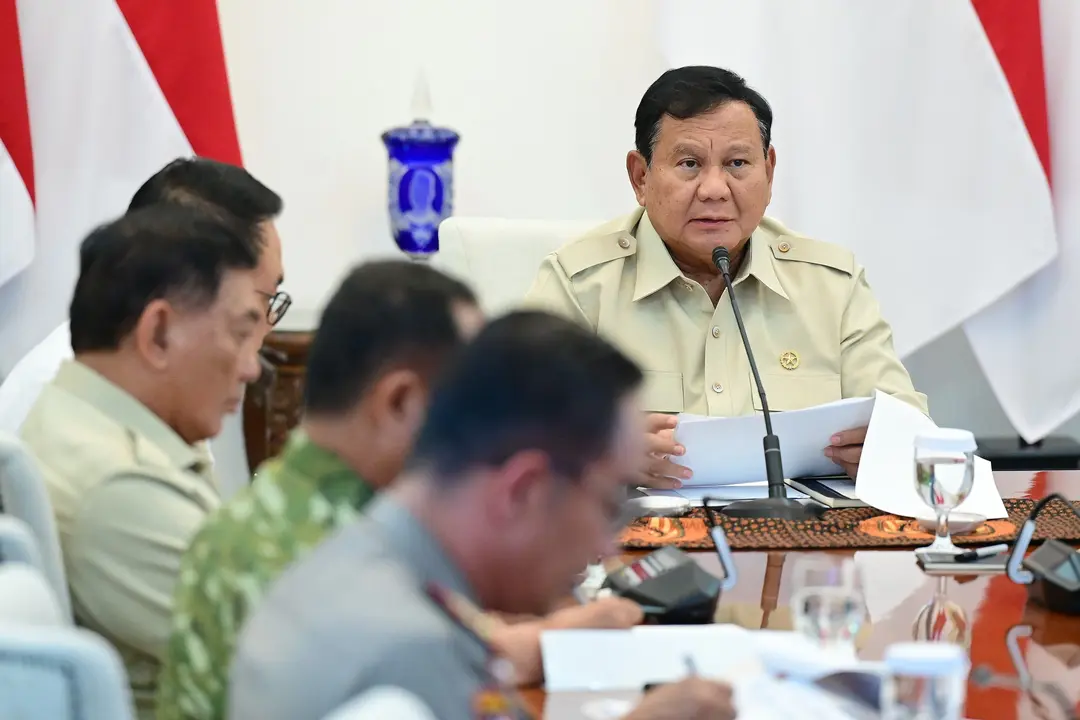
JAKARTA — Indonesian President Prabowo Subianto has ordered government agencies to mobilize all available resources to accelerate efforts to combat forest and land fires across the country. In addition to strengthening firefighting operations, Prabowo has called for an expansion of the forest ranger workforce to 70,000 personnel as part of a broader effort to improve forest protection.
The directive was issued during a limited cabinet meeting chaired by Prabowo at the Merdeka Palace in Jakarta on Monday, October 12, 2026. The government has prioritized fire suppression efforts in Central Kalimantan and South Sumatra, while Tanjung Puting National Park has also received particular attention.
During the meeting, Prabowo instructed relevant agencies not to hesitate to request additional personnel, equipment, and logistical support needed to accelerate firefighting operations.
“This is an extremely high priority for us. We must address this immediately,” Prabowo said, according to a report published by Media Indonesia on Tuesday, October 13, 2026.
Prabowo Calls for 70,000 Forest Rangers
One of the key elements of the president’s directive is a plan to strengthen fire prevention by expanding Indonesia’s forest ranger workforce. Prabowo considers the existing number of personnel insufficient to monitor the country’s vast forest areas and respond effectively to the threat of wildfires.
The president also asked the National Police chief to support the training and preparation of new personnel. The initiative is expected to strengthen forest surveillance and improve fire prevention efforts at the regional level.
According to Media Indonesia, Prabowo emphasized that the government must not rely solely on extinguishing fires after they break out. Instead, authorities need to develop more comprehensive mitigation and prevention measures, extending down to the village level.
The strategy will require coordination among government agencies, regional administrations, security personnel, and academics with expertise in local environmental conditions.
The proposed target of 70,000 forest rangers represents a workforce expansion plan announced by the president. However, detailed recruitment stages, budget requirements, and a timeline for achieving the target have not yet been fully outlined in the available reports.
Tanjung Puting National Park Becomes a Priority
Beyond strengthening the workforce, Prabowo has placed particular emphasis on fires affecting Tanjung Puting National Park in Central Kalimantan.
The protected area is internationally recognized for its conservation value, particularly as a habitat for orangutans and other wildlife. Fires in conservation zones threaten animal habitats and can undermine efforts to preserve Indonesia’s biodiversity.
During the October 12 meeting, National Disaster Mitigation Agency (BNPB) Chief Suharyanto reported that 639.23 hectares of land were still burning across six provinces and remained under active firefighting operations.
Of that total, fires in and around Tanjung Puting were reported to have affected 513.89 hectares.
The six provinces receiving attention in the firefighting campaign are Central Kalimantan, South Sumatra, South Kalimantan, Jambi, West Kalimantan, and Riau.
Government reports identified Central Kalimantan and South Sumatra as among the areas facing the most challenging firefighting conditions. Meanwhile, conditions in Riau, West Kalimantan, Jambi, and South Kalimantan were reported to have improved, although firefighting operations continued.
The figure of 639.23 hectares refers to land that was still burning and under active response at the time of the report. It should not be confused with the cumulative area affected by fires throughout 2026.
Thick Haze Hampers Aerial Firefighting Operations
One of the main challenges facing firefighters is thick smoke, which has reduced visibility in several fire-affected areas.
The BNPB chief reported that the conditions had disrupted helicopter water-bombing missions and other aerial operations, particularly in Central Kalimantan. As a result, ground crews have had to take a larger role in reaching fire hotspots and preventing the flames from spreading.
The government continues to deploy aerial support wherever conditions permit, including helicopter water-bombing operations and weather modification efforts.
Weather modification operations are intended to encourage rainfall by making use of suitable cloud formations, potentially supporting firefighting efforts.
According to government statements, weather modification operations are being optimized as the rainy season is expected to expand across parts of Indonesia in mid-to-late October 2026. However, the success of firefighting efforts will continue to depend on weather conditions, access to affected locations, and the ability of ground crews to contain remaining hotspots.
Reuters Highlights Haze Impacts and International Pressure
In a report published on October 13, 2026, Reuters highlighted the growing impact of smoke from Indonesian wildfires, including health concerns among residents and deteriorating air quality in neighbouring countries.
Reuters reported that the number of respiratory illness cases associated with fires in seven Indonesian provinces had reached 277,075 as of October 12. That figure was more than double the 113,336 cases recorded on September 9, 2026.
The haze has also spread to Malaysia and Singapore. Reuters reported that schools in several Malaysian areas had been closed because of deteriorating air quality. Both countries have also offered assistance to support Indonesia’s firefighting efforts.
However, Indonesia had not decided to accept foreign assistance or declare a national disaster status at the time of the report. Coordinating Minister for Political and Security Affairs Dudung Abdurachman said the government remained capable of managing the situation.
Reuters also highlighted differences in estimates of the total area affected by fires.
Official government figures cited by the news agency were based on data through July 2026, when the burned area had reached approximately 202,000 hectares. Environmental organization Auriga estimated that more than 637,000 hectares had been affected between January and August, while deforestation monitoring platform Nusantara Atlas put the figure at nearly 900,000 hectares.
These estimates were produced by different organizations and should not be directly equated with government figures that had not been updated for the same period.
Government Urged to Strengthen Fire Prevention
Prabowo’s directives indicate that the government is pursuing two parallel approaches to the wildfire crisis: accelerating firefighting operations and strengthening long-term prevention.
Expanding the forest ranger workforce is expected to improve surveillance in areas vulnerable to fires. Meanwhile, ground operations, aerial support, weather modification, and coordination between central and regional authorities remain essential to containing ongoing fires.
The next challenge will be translating the proposed workforce expansion into a measurable implementation plan. The government will also need to ensure that sufficient equipment, funding, and coordination mechanisms are available to sustain prevention efforts.
With the effects of wildfires extending to public health, forest conservation, and cross-border air quality, the success of the government’s strategy will depend heavily on implementation in the field and its ability to prevent recurring fires.
As of October 14, 2026, firefighting operations were continuing in several parts of Indonesia. The government has pledged to continue deploying available resources to accelerate suppression efforts, with Central Kalimantan and South Sumatra remaining key priorities and Tanjung Puting National Park among the areas receiving special attention.
Sources: The Presidential Secretariat of Indonesia, Media Indonesia, and Reuters.




Komentar